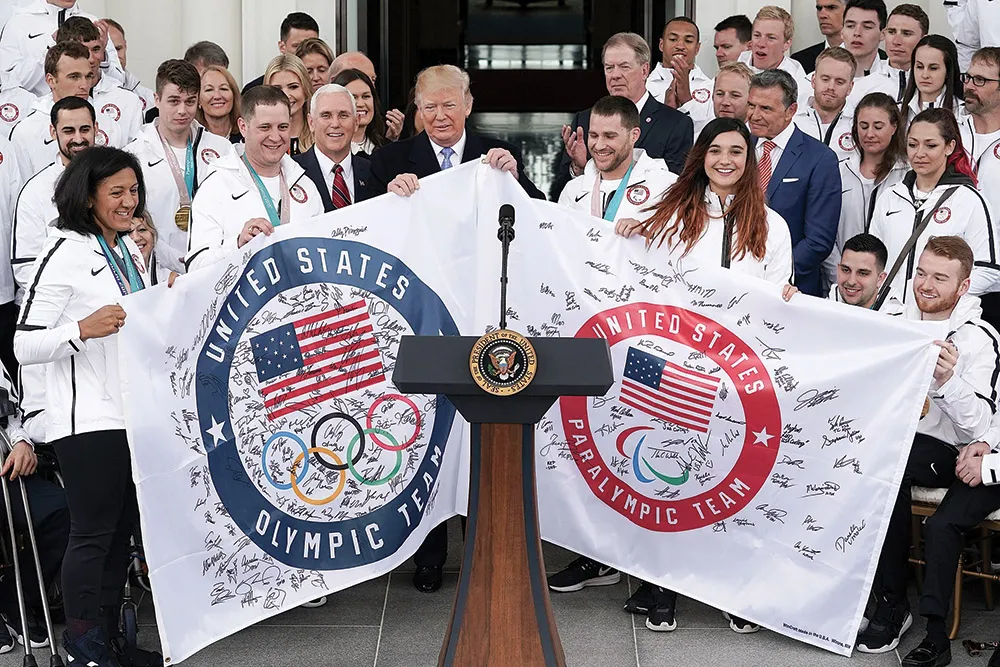
President Trump’s history with the Olympics includes hosting Team USA at the White House in 2018
The impending influence of Donald Trump on the 2028 Los Angeles Olympic Games remains a topic surrounded by considerable uncertainty. As the event approaches, there is a growing sense that political turbulence could complicate the city’s journey to Olympic glory. Trump’s presidency has been characterized by a hard-line approach to immigration, aggressive cuts to federal services, and controversial foreign policies. These stances run counter to the Olympic values of global unity and inclusivity. Despite private reassurances to the LA28 committee during a meeting at Mar-a-Lago, where he emphasized, “these are America’s Olympics,” experts are skeptical about the impact of his policies. There are increasing fears that the Games, concluding his second term, could become a historic embarrassment for the U.S. due to his international policies that have strained relations worldwide.
Jonathan Aronson, an international policy expert from USC, highlights the potential for diplomatic boycotts, stating, “If he alienates other countries too much, what greater insult is there than not to come at all?” While Trump’s controversial tariffs may not directly affect the financials of the Los Angeles Games, his administration’s stance on visas could create significant hurdles. The “no-build” strategy, which relies on existing infrastructure, could be hindered by anticipated visa complications affecting everyone from athletes to coaches, sponsors, and spectators. The U.S. Travel Association, in a February report, voiced concerns about visa processing delays for major U.S. events, citing findings from former high-ranking officials in Homeland Security and other relevant agencies.
LA28 chair Casey Wasserman, a key figure in sports and entertainment management, reassured the International Olympic Committee in March that the U.S. would be welcoming to all participants, despite current political tensions. He emphasized, “L.A. is the most diverse city in the history of humanity,” and promised that visa issues would be addressed through a dedicated desk at the State Department. However, concerns about delays in processing persist. Emma Prodromou of the Mauve Group warns, “Without additional resources, visa processing delays seem likely,” suggesting that administrative issues could disrupt the smooth operation of the event. Karine Faure Wenger, from law firm Fragomen, described the situation as “very fluid,” indicating that Trump’s administration might need to make significant concessions, especially concerning countries the U.S. does not have diplomatic relations with, such as North Korea and Iran.
The 2026 FIFA World Cup, which will be jointly hosted by the U.S., Canada, and Mexico, is seen as a precursor to the 2028 Games. FIFA president Gianni Infantino, a figure closely tied to Trump, expressed optimism about the event’s success, despite ongoing diplomatic concerns. He remarked, “Next year there will be an invasion of America but an invasion of people who come to celebrate with a positive spirit.” However, this optimism is tempered by Trump’s recent travel ban, imposed on June 4, which targets several countries in Africa and the Middle East, although athletes and their families are exempt. The response from these affected nations remains uncertain.
Security for both the 2026 World Cup and the 2028 Olympics will be tight, with the U.S. Secret Service taking the lead in overseeing the National Special Security Events alongside the FBI and Homeland Security. According to Pacific University professor Jules Boykoff, “Trump and his administration will hold considerable leverage over state and local officials,” potentially influencing local policies. L.A. Mayor Karen Bass, along with other local officials, has requested $3.2 billion in financial support from Trump to improve transportation infrastructure in preparation for the Games, particularly to expand the bus fleet in anticipation of the large crowds. However, concerns linger over potential political concessions in exchange for financial aid, such as measures targeting undocumented residents and addressing homelessness in high-profile areas.
Before his 2022 election, City Councilman Hugo Soto-Martínez, who is affiliated with the NOlympics LA movement, opposed the Games, fearing Trump’s financial influence. Trump, known for his love of grand sports spectacles, could relish the opportunity to once again be in the spotlight during the 2028 Olympics. As Fox News commentator Jesse Watters noted, “he’s running out of events to go to,” ensuring that his presence will be a given. NYU professor Christopher Gaffney predicts that Trump’s influence will extend to the opening ceremony, potentially attracting other authoritarian world leaders to join him. California Governor Gavin Newsom, among others, believes that Trump sees the Games as an opportunity to solidify his legacy, commenting on NBC’s Meet the Press, “This is an opportunity for him to shine.” Aronson adds, “Presuming he doesn’t try to run for a third term, this will be his swan song, and it’s in his interest to put on a good show.”
This evolving situation is not without its complexities. While Trump’s administration could exert substantial influence on the success of the 2028 Games, his political actions and decisions remain unpredictable. As the Games draw closer, it will be fascinating to see how the global community and local authorities navigate these challenges.