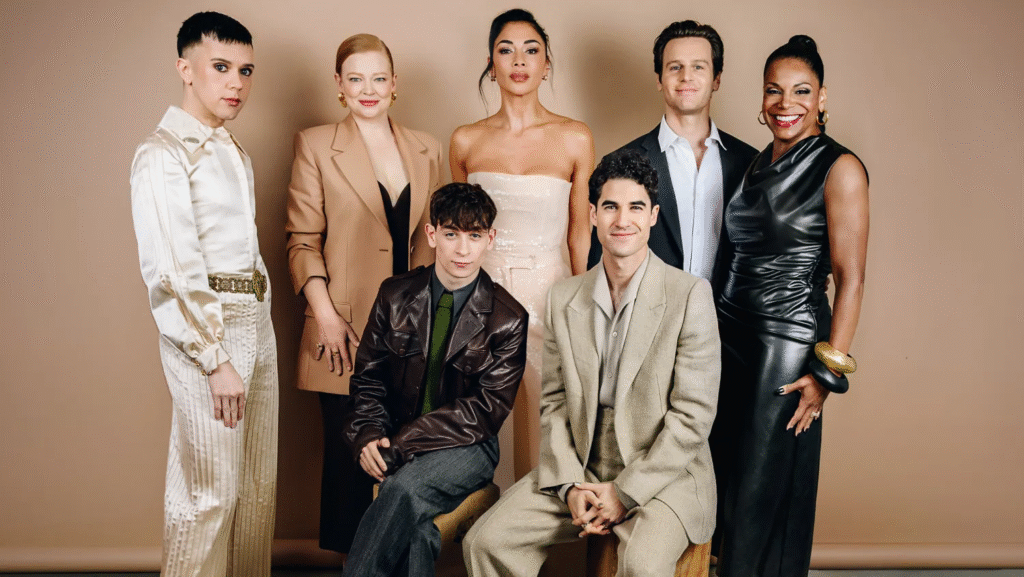
Cole Escola, Sarah Snook, Louis McCartney, Nicole Scherzinger, Darren Criss, Jonathan Groff and Audra McDonald
As the 78th Tony Awards near at Radio City Music Hall in New York, The Hollywood Reporter gathered a remarkable ensemble of Broadway’s finest, including Sarah Snook, Darren Criss, Nicole Scherzinger, Jonathan Groff, Audra McDonald, Cole Escola, and Louis McCartney. The group engaged in a thought-provoking conversation about their Tony-nominated performances, touching on pressing issues such as nontraditional casting, gender-neutral awards, and the integration of digital technology into live theater.
This year’s nominees showcase an array of Broadway talent and diverse backgrounds: McDonald, with an impressive 11 Tony nominations and six wins, continues to set records as a Broadway icon. Groff, recently celebrated for his performance in Merrily We Roll Along, joins the ranks with four nominations. First-time nominees include Scherzinger, who gained fame with the Pussycat Dolls; Criss, known for Glee and his Emmy-winning role in The Assassination of Gianni Versace: American Crime Story; and Snook, recognized for her acclaimed role in Succession. Rising stars include Escola, a non-binary artist and Pulitzer finalist, and McCartney, who shines in his debut Broadway season.
Criss marvels at the diversity of the group’s backgrounds, remarking, “What the fuck is going on here? That’s incredible!” His astonishment highlights the groundbreaking nature of modern casting, which includes a Northern Irish actor portraying an American teen, a multi-ethnic actress embodying Norma Desmond, and Escola playing Mary Todd Lincoln. Criss himself portrays an Asian-American character in a futuristic setting, further exemplifying the shifting landscape of casting choices.
The group credits their mentors and personal experiences for grounding them in the demanding world of Broadway. Criss thanks his loved ones for helping him balance the challenges of parenting and theater. McCartney praises director Justin Martin’s supportive guidance, while McDonald recalls the pivotal influence of legendary actress Zoe Caldwell, whose professional insights transformed her approach to acting.
As they share personal projects, Escola humorously recounts their fascination with Mary Todd Lincoln, comparing it to self-discovery themes similar to those explored in Scherzinger’s portrayal of Norma and McDonald’s role as Rose. McDonald also reflects on a touching memory of the late Gavin Creel, who had envisioned her starring in Gypsy.
Groff, inspired by singer Bobby Darin’s resilience, discusses his long-term exploration of the artist, which culminated in a live acoustic performance at Circle in the Square. He describes the experience as “like drugs” due to the electric connection with the audience. Scherzinger recalls her roots at Louisville’s Actors Theatre and contrasts it with her fame in the Pussycat Dolls, recalling how Andrew Lloyd Webber praised her performance in Sunset Blvd. as the best of his project.
Criss passionately describes the unique storytelling of Maybe Happy Ending, emphasizing its fresh approach to theater and the audience’s response, which avoided prior comparisons. Snook recounts how her involvement in The Picture of Dorian Gray came about serendipitously, with the role demanding her to juggle complex prose dialogue while balancing motherhood.
For McCartney, stepping into the world of Stranger Things was influenced by his father’s YouTube channel and earlier roles. He reflects on the challenge of adding unique nuances to the beloved fictional elements while respecting their established legacy.
Groff takes a moment to honor Lin-Manuel Miranda’s genius and the cultural impact of Hamilton, witnessing its evolution from an Off-Broadway experiment to a global phenomenon. McDonald also shares her perspective on casting choices, emphasizing that her theater family’s belief in empowering underrepresented voices through “making them say no” has been integral to her success.
Escola addresses the ongoing conversation about gender-neutral categories at award shows, advocating for inclusivity and self-expression in the industry. Meanwhile, the integration of digital screens into live theater, explored by Snook, Scherzinger, and McCartney, is highlighted as a crucial development that amplifies the storytelling experience for modern, generational audiences.
Amid the intense physical demands of live theater, performers have developed unique strategies for wellness. Criss shares his use of Scandinavian therapies, while McDonald discusses her ritualistic preparations for maintaining stamina. Each actor compares their transition between mediums, with Escola humorously recalling feedback to “lessen” their theatricality onscreen, while McDonald notes the strength found in subtler expressions in film.
Ultimately, the unpredictability of audience interactions shapes their perceptions of performances. Criss recounts the depth of audience engagement, with spontaneous exchanges reflecting the beauty of cross-disciplinary talent.
In closing, each nominee reflects on their cherished connections and quirky backstage moments, offering a glimpse into the rich, multifaceted world of Broadway.