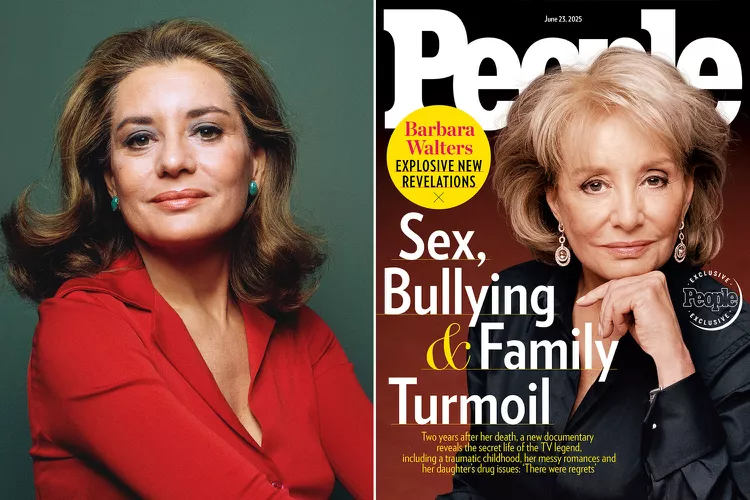
Left: Barbara Walters ca 1972; Right: The June 23, 2025
However, beneath the public persona of this pioneering journalist lay a struggle-filled journey, a saga explored in the compelling new documentary, Barbara Walters Tell Me Everything, which premieres June 12 at the Tribeca Festival and begins streaming on Hulu from June 23.
Most recall Walters in her later years: iconic blonde hair, sharp debates on The View, and heart-wrenching celebrity interviews. Yet, this documentary unpacks the obstacles she faced climbing to become the first female co-anchor on nightly network news television. The film delves into the rampant sexism plaguing her career and how her relentless pursuit of excellence came at the cost of her personal life.
As recounted in this week’s PEOPLE cover story, Walters’ path to success was fraught with roadblocks and peril. David Sloan, her long-time confidant and now an executive producer at ABC News, notes, “Her path wasn’t easy; it was full of challenges and doubters.” Walters retreated from public life in 2019, navigating through personal trials, including dementia, before she passed away in 2022 at the age of 93.
Despite her tremendous success, Walters was burdened with insecurities, particularly about her appearance. A sentiment echoed by her friends and peers, with Katie Couric recounting in the documentary, “Oh, we’re so alike: Neither of us is that attractive,” Walters would admit.
These insecurities likely found roots in a turbulent childhood, set against the backdrop of her father’s nightclub business and the subsequent financial and social upheaval when it failed. This abrupt transition thrust Walters into the role of sole provider, a duty she embraced solemnly, as recalled by Cynthia McFadden, former NBC correspondent.
In 1976, breaking new ground, ABC brought Walters on as the first female co-anchor of their nightly news opposite Harry Reasoner. She was entering uncharted territory, and despite the prestige, the reality often bordered on nightmarish. She faced harsh opposition from male colleagues not keen on sharing the limelight.
“Harry was downright rude,” McFadden reflects. Walters herself recounted in resurfaced commentary, feeling isolated in a hostile environment, “I would walk into that studio, and they’d all crack jokes and ignore me. It was excruciating.”
Still, Walters distinguished herself as a formidable interviewer in the industry, starting with her specials in 1976. Oprah Winfrey praises her fearless questioning, “She asked what others wouldn’t dare.”
Not all interviews were well-received.
“Some questions might not have aged well,” McFadden concedes with a light laugh, while Midler notes, “Walters could really dig in.” In one of her earliest specials, Walters famously asked Barbra Streisand, “Why didn’t you have your nose fixed?” Another time, she directly questioned Vladimir Putin about ordering assassinations.
Walters once confronted Martha Stewart, remarking, “Martha, why do so many people hate you?” When told that everyone has both admirers and detractors, Walters retorted, “No, not everyone has people that hate them.”
Her candid nature was equally evident in a now-famous exchange with reality sensations the Kardashians in 2014. “You don’t act, you don’t sing, you don’t dance, you don’t have any forgive me talent,” she bluntly told them. Taylor Swift, equally taken aback, faced Walters’ pinpoint questions about her songwriting.
“A Barbara interview was an endurance test,” McFadden jokes.
For insights into Walters’ legacy, get this week’s issue of PEOPLE, available starting Friday.
Those closest to her defend her approach to journalism. “She was always painstakingly prepared,” Sloan asserts, highlighting her rigorous approach to interviews.
Walters’ legacy is believed to have transformed how journalists approach interviews. Reflect on her querying Chris Christie, former New Jersey governor and then-presidential hopeful, “Aren’t you too fat to be President?” These are the questions viewers at home pondered.