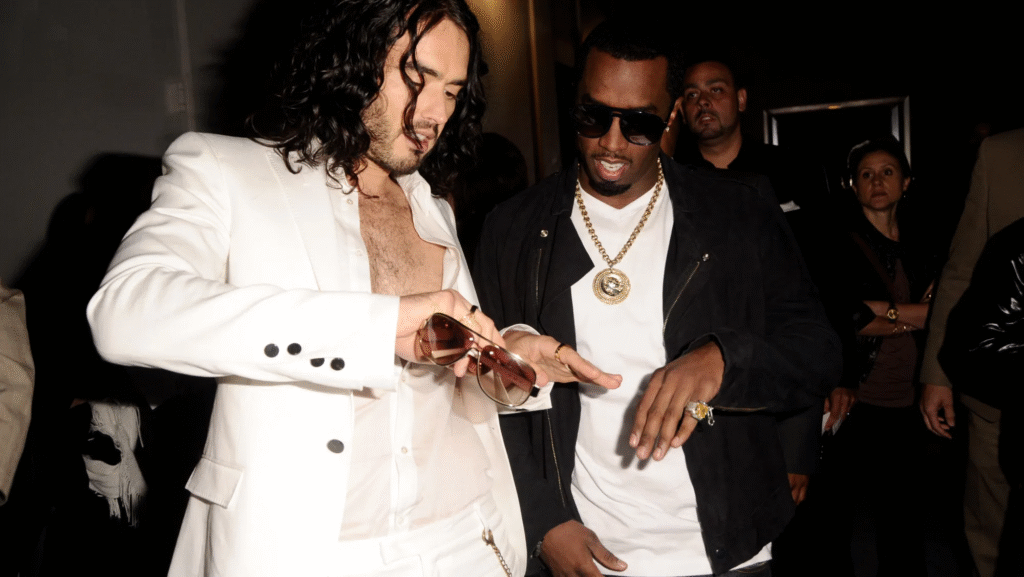
Russell Brand and Sean Combs attend the Los Angeles premiere of "Get Him To The Greek" at The Greek Theatre on May 25, 2010 in Los Angeles, California.
A trailblazer in hip-hop and a figure of glamor, Diddy has expanded his empire over three decades into fashion and beyond. Now in stark contrast, Get Him to the Greek, a Judd Apatow-produced comedy from 2010 featuring Combs, is being reevaluated as it unveils perhaps more truth about Combs’ reality than understood back then. In this piece, we explore how this film eerily mirrors allegations and testimonies surfacing during the ongoing trial.
Sean Combs faces charges as the overseer of a criminal enterprise accused of numerous crimes, ranging from sex trafficking to obstruction of justice. Pleading not guilty, he denies all accusations. Meanwhile, Get Him to the Greek, a satire on the music industry, showcases Combs in his most notable cinema role as Sergio Roma, a character who displays malice that now seems unsettlingly aligned with Combs’ real-life accusations.
Employee Abuse Allegations
Throughout the trial, numerous former assistants have recounted experiences of mistreatment by Diddy. Former assistant David James described Combs’ work environment as dictatorial, referencing a time he was coerced with footage of drug-induced behavior to ensure compliance. Similar intimidation tactics were recounted by longtime employee Capricorn Clark, who testified about an incident involving kidnapping.
In Get Him to the Greek, Jonah Hill’s character, Aaron, encounters hostile antics from Combs’ Sergio. A particularly jarring scene includes Combs belittling an employee about managing through a phone call during a meeting, and later goading Aaron into uncomfortable situations, parallel to allegations of exploitation in real life.
A notable line from the movie encapsulates this abusive power dynamic, as Sergio declares his immunity to challenges due to his wealth, alienating his underlings in the process.
Drug Smuggling Encouragement
Combs has been accused of orchestrating drug operations, as detailed by former assistant George Kaplan’s harrowing court testimony about drug deliveries and coerced distributions. With immunity granted for his trial revelations, Kaplan described actions disturbingly akin to those depicted comedically in the film.
In a scene reminiscent of these accusations, Combs’ character nonchalantly persuades Hill to smuggle drugs, dismissing any potential harm.
Rampant, Wild Parties
A pivotal moment in the comedy shows Sergio partaking in chaotic, drug-fueled debauchery, which echoes testimonies around Combs’ infamous ‘freak-off’ parties. Witnesses described these gatherings as drug-driven sexual escapades, often violent, casting a sinister reality to extravagant assertions made throughout the film.
Filmed scenes of such revelry in Get Him to the Greek align close to witness depictions, with Combs’ character embodying the chaotic excesses Combs is now accused of orchestrating. The narrative’s climax shows a frenzied Sergio, further antagonizing Hill, mirroring real-world allegations.
Staff Sexual Assault Allegations
Mia, a key witness whose identity remains protected, accused Combs of sexual assaults endured during her tenure as an assistant. Similar troubling complaints were raised by Lil’ Rod, shaking the perception of Combs’ public persona.
This power imbalance is starkly portrayed in Get Him to the Greek, when Combs’ Sergio demands Aaron partake in an unwanted sexual encounter, culminating in a bewildering yet disturbingly accurate commentary on abuse of power.
Get Him to the Greek finds new relevance as Combs’ trial continues. These parallels between the fiction of Sergio Roma and the realities of Sean Combs are unsettling, offering both a foretelling and cautionary tale. For those intrigued or seeking deeper insight, the film is available for streaming on Netflix.