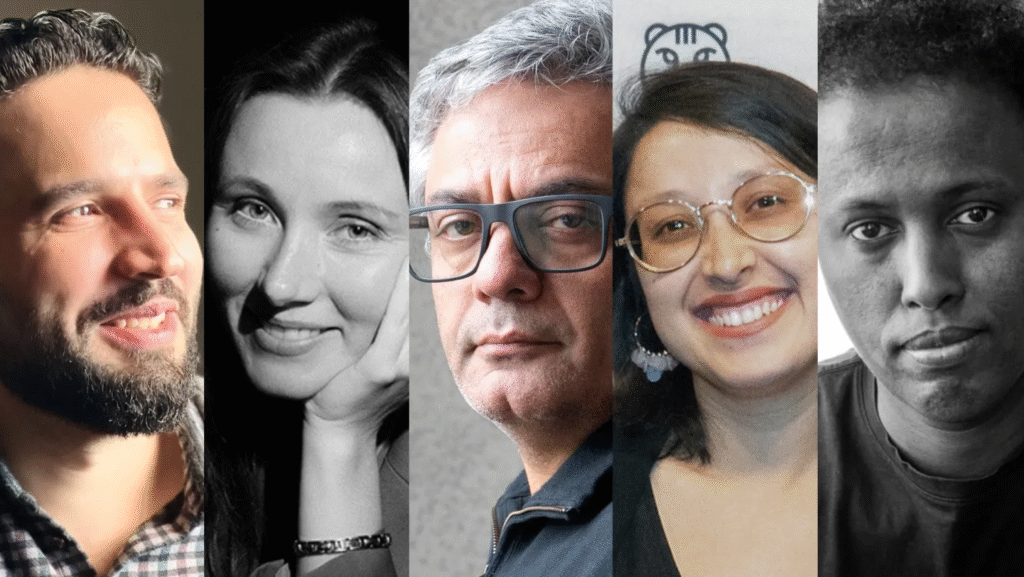
from left to right: Hassan Kattan, Maryna Er Gorbach (credit: Rafal Nowak), Mohammad Rasoulof, Shahrbanoo Sadat, Mo Harawe
Cate Blanchett Champions Bold New Voices with Film Fund for Displaced Directors
“Part of the DNA of the fund is to reject and challenge the stereotypes around what it means to be displaced,” says Cate Blanchett. That mission now has real momentum.
At Cannes, Blanchett introduced the Displacement Film Fund, a new short film grant co-launched with the International Film Festival Rotterdam’s Hubert Bals Fund. The initiative supports five remarkable filmmakers from Iran, Syria, Afghanistan, Somalia, and Ukraine, each chosen for their powerful storytelling rooted in the experience of displacement.
Blanchett described the project as a way to bring underrepresented voices to the forefront. “This is a call to the film industry to find real platforms for these filmmakers,” she told The Hollywood Reporter. Joining her at the launch were IFFR director Clare Stewart, MoMA film curator Rajendra Roy, and selected filmmakers like Maryna Er Gorbach (Klondike) and Mo Harawe (The Village Next to Paradise).
The program, offering €100,000 grants to each recipient, aims to create deeply personal short films that reframe the idea of displacement beyond cliché.
Afghan director Shahrbanoo Sadat, now based in Germany, opened up about her upcoming film Female Fitness of Kabul. “It’s about Afghan housewives reclaiming their bodies and identities inside a run-down gym,” she said. Her journey is deeply personal—“I was born to Afghan refugees in Iran. I was an Afghan in Iran, and Iranian in Afghanistan. I never quite belonged.”
Sadat added that over time, she came to see displacement not just as a geographic condition but one tied to gender and systemic exclusion. “Every attempt to integrate made me feel more rejected,” she said. “This gym becomes a symbol of quiet resistance.”
Syrian filmmaker Hasan Kattan, who made Last Men in Aleppo, shared the premise of his new short Allies in Exile. “It’s about two Syrian filmmakers bonded by 14 years of war, now navigating the U.K. asylum system,” he explained. The twist comes when one gains asylum and the other is forced to return to a changed Syria. “The hardest part of exile isn’t just escape—it’s what comes after,” Kattan said.
He admitted the grant arrived just in time. “I had almost given up on this project due to my circumstances in the U.K. asylum system. This funding revived my faith in the story—and in storytelling as survival.”
Three other selected filmmakers also presented bold new concepts:
- Mohammad Rasoulof, honored for a project about a family grappling with the burial wishes of a late exiled writer.
- Mo Harawe with Whispers of a Burning Scent, which follows a man on the verge of divorce as he reflects on his place in his fractured family.
- Maryna Er Gorbach with Silk Road, a road movie about a Ukrainian woman torn between her children in Europe and her duty at a Kyiv children’s hospital during wartime.
The fund’s jury includes notable figures like Cynthia Erivo, Agnieszka Holland, Waad Al-Kateab, and Jonas Poher Rasmussen (Flee), with Blanchett as chair.
Blanchett reflected on the urgency of the cause: “When I began as UNHCR Goodwill Ambassador, there were 60 million displaced people. Today, it’s over 120 million. But even in displacement, people remain whole—mothers remain mothers, artists remain artists.”
The selected short films are expected to premiere at IFFR next year, but Blanchett insists that won’t be the end. “Clare and I are committed to ensuring these films don’t stop at the festival circuit,” she said.
She emphasized that these stories go beyond tragedy. “They are surprising—romantic, thrilling, funny. You don’t realize the filmmaker is displaced until you’re already moved. And that’s the power.”
For Blanchett, this marks just the beginning of a much larger effort to restore opportunity and visibility to filmmakers whose creative lives were interrupted by displacement—and to reframe how the world hears their stories.