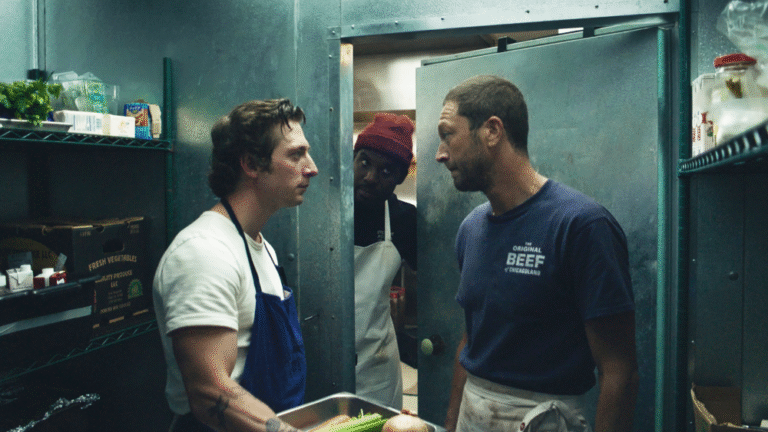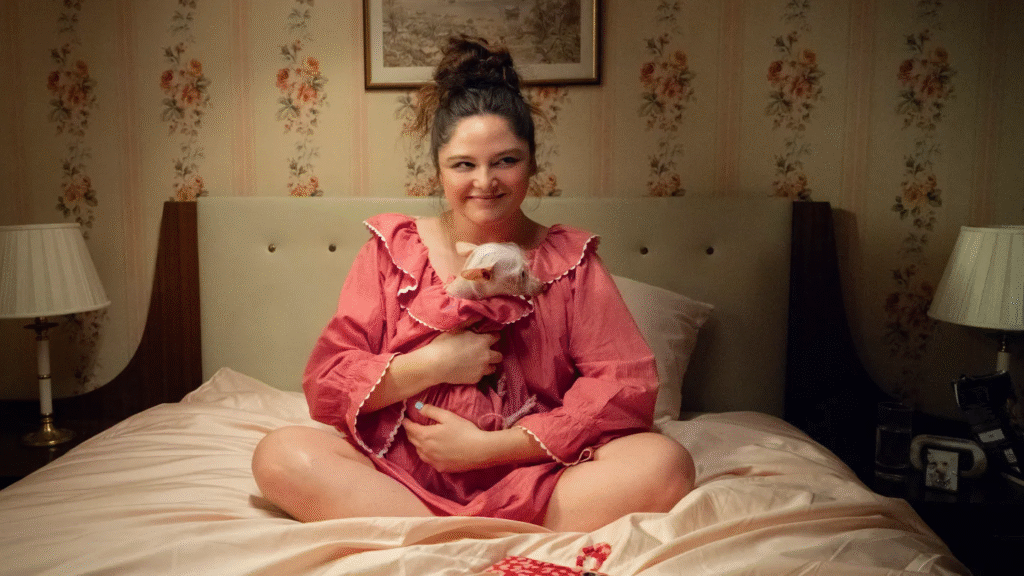
Megan Stalter in 'Too Much.'
Megan Stalter and Will Sharpe headline a London-based love story born from the creative minds of ‘Girls’ creator Lena Dunham and her husband, Luis Felber. The series draws inspiration from their whirlwind romance, tracing its roots back to their own experiences.
In a poignant scene closing the second episode, Jess (Megan Stalter), the outspoken American heroine of Netflix’s ‘Too Much’, relaxes with a mixtape compiled by her new British love interest, Felix (Will Sharpe). With headphones in place, Felix reclines beside her, content without words or physical affection, the camera capturing their serene expressions and the unique connection they share. This simple yet profound intimacy strikes a rare chord in the show.
A Charming Yet Distant Romance
While ‘Too Much’ draws from Dunham and Felber’s real-life courtship, candidly exploring its characters’ flaws with the insight of seasoned therapists, it struggles to fully immerse itself in the emotional depth required for a compelling love story. Consequently, the series delivers a romance that is charming yet distant, failing to spark passionate engagement.
The Opening Scene sets the stage for this emotional distance as Jess, under Dunham’s direction, dramatically enters the Brooklyn apartment of her ex, Zev (Michael Zegen), disrupting his life with his influencer girlfriend (Emily Ratajkowski). The premiere grimly transitions to Jess’s London adventure, where her fresh start quickly unravels with an accidental fiery mishap, humorously embodying the chaotic charm of her rom-com idols, yet skirting on messy.
Unconventional Leads and Witty Dialogue
Similarly, Mr. Darcy’s contemporary counterpart, Felix, is far from a conventional romantic lead. An indie musician struggling with past addictions and trauma, Felix’s vulnerabilities become heart-wrenchingly clear as the season progresses. The series meticulously chronicles their intense relationship, from blissful nights rendered physically impossible to volatile arguments during high-society events.
Central to this is the humor-laden dialogue crafted by Dunham and Felber, infused with enough wit to enhance reality without veering into self-absorption. Jess’s character, encapsulated in a witty line lamenting her constantly adjusted dreams, and the quirky charm between her and Felix, sprouting from darkly comedic exchanges, adds vibrancy to their bond. Additionally, through Jess’s family interactions — her sister Nora (Dunham), mother Lois (Rita Wilson), and grandmother Dottie (Rhea Perlman) — the quick-witted, affectionate banter paints a vivid picture of their intertwined lives. Zev’s ex-boyfriend antics also surface through veiled criticisms masked as flattery.
Emotional Aloofness and Missed Opportunities
Yet, despite expertly crafted characters and engaging dialogue, ‘Too Much’ remains emotionally aloof, narrating experiences without enveloping the audience. Subplots involving Jess’s colleagues, such as her authoritative boss (Richard E. Grant), are portrayed superficially. Major developments transpire offscreen, resembling sporadic social media updates rather than immersive storytelling.
The disconnection pervades Jess and Felix’s unfolding romance. Although Stalter’s portrayal captures Jess’s quieter, vulnerable states effectively, she struggles with the character’s bolder outbursts. Here, where emotional exaggerations risk comedic overshadowing, her performance feels less anchored than her co-stars, Sharpe and Zegen. The definitive lack of intimate focus on their central couple’s dynamics diminishes the romantic engagement, sidestepping the intense glances and close-ups essential for fostering viewer immersion.
While plenty of sexual and conversational interactions occur, they lack the emotional resonance required to allure audiences, leaving the narrative feeling more like a therapeutic recounting than a captivating romantic escapade. Without fostering an immersive desire, ‘Too Much’ translates as a clinical observation rather than a sweeping romantic journey, substituting genuine engagement with distant analysis. Transforming potential passion into mere commentary, the series inadvertently holds a mirror up to its own thematic challenges.