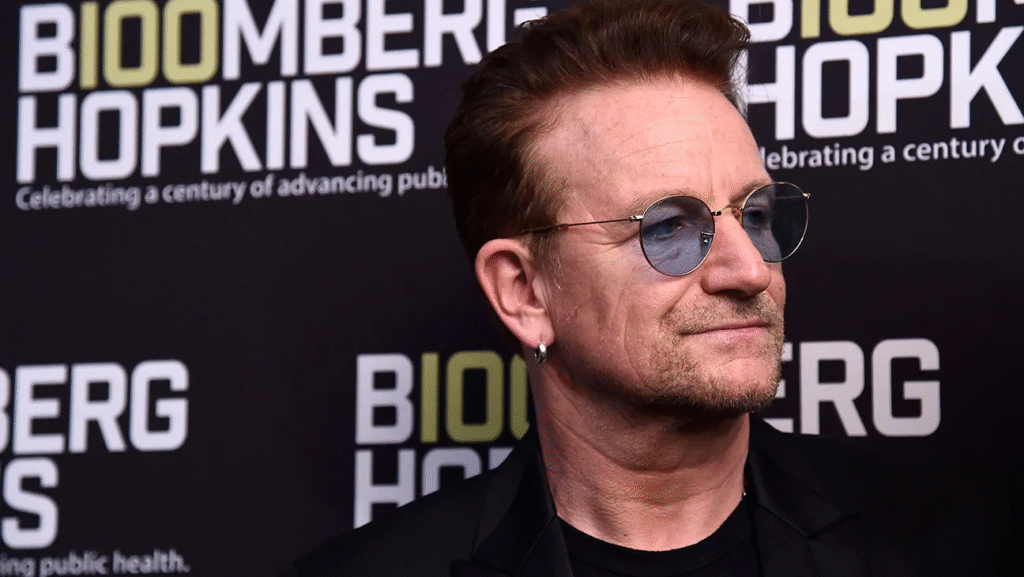
U2’s legendary frontman Bono recently joined Joe Rogan for a thought-provoking conversation that traversed politics, global aid, and the sobering consequences of billionaire Elon Musk’s contentious DOGE initiative. With a conviction forged from decades of humanitarian work, Bono sounded the alarm on the Trump administration’s sweeping budget cuts specifically those that have gutted the United States Agency for International Development (USAID), a program long revered for delivering life-saving aid across more than 120 countries.
From famine zones to war-ravaged health clinics, Bono has witnessed firsthand how USAID operates. On the podcast, he referenced emerging data suggesting that the proposed DOGE-aligned cuts could result in over 300,000 preventable deaths, with children making up the majority many at risk from malnutrition, malaria, and pneumonia. “There’s food rotting in boats and warehouses,” Bono lamented, “50,000 tons of it. And the very people who distribute it fired. That’s not the America I know.”
While acknowledging the necessity of fiscal responsibility, Bono made clear his disdain for what he called “the joyful dismantling” of institutions designed to serve the world’s most vulnerable. “To destroy not by accident, but by design these instruments of mercy… is it too much to call that evil?” he mused, quoting a haunting report from Christianity Today, in which a health worker described choosing which child to remove from an IV due to lack of funds. “There’s something unspeakably dark in letting a child die, not from disease, but from bureaucracy,” he added.
Bono also revealed his outreach to Secretary of State Marco Rubio, who, according to him, denied the dire consequences unfolding from these funding cuts. Rogan countered with skepticism, questioning USAID’s integrity and citing accusations of corruption, fraud, and financial mismanagement allegations that have long shadowed the agency despite its impact. “Billions lost and no one’s held accountable,” Rogan remarked, though he conceded, “But surely we could’ve solved fraud without slashing the core of global compassion.”
Notably, following Musk’s labeling of USAID as a “criminal organization,” most of its staff were furloughed in February 2025. Musk later dismissed Bono’s warnings via X, calling him a “liar and an idiot,” and insisted “Zero people have died.” Analysts suggest this rebuttal hinges on semantics rejecting projected death tolls rather than acknowledging growing humanitarian crises.
Bono’s concerns are not without support. Brooke Nichols, a Boston University epidemiologist, warned in The Times UK that halted health programs have already contributed to tens of thousands of preventable child deaths, citing spikes in diarrhea, pneumonia, and severe malnutrition. “The silence around these deaths makes them even more devastating,” she noted.
Bill Gates also joined the chorus of critics, telling The Financial Times, “When the richest man in the world dismantles what saves the poorest children, the symbolism alone is staggering.”
Toward the end of the discussion, Bono returned to a larger philosophical point one that transcends policy and politics. “America was never just a place it was an idea,” he said. “But when we retreat inward, that idea shrinks. A country that once stretched across the moral geography of the world begins to look less like a continent and more like an island.”
In a time when populism, austerity, and billionaire idealism increasingly dictate humanitarian outcomes, Bono’s voice emerges not just as a musician’s but as a conscience urging America not to forget the weight of its promise to the world.