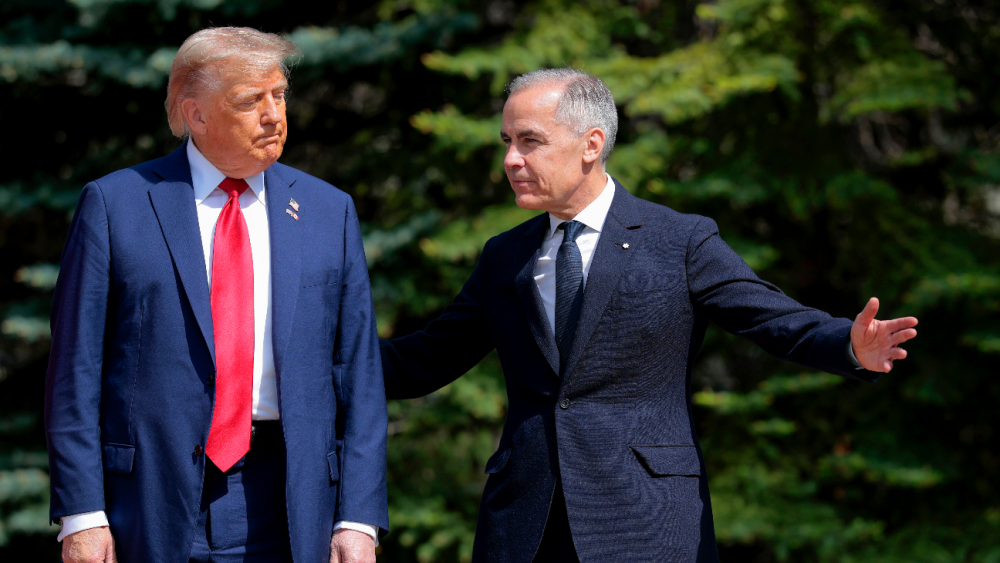
Canadian Prime Minister Mark Carney (R) greets U.S. President Donald Trump at the official welcome ceremony during the G7 Leaders' Summit on June 16, 2025.
In a decisive turn of events, Canada has stepped back from its contentious digital services tax, reopening trade negotiations with the United States. This tax, poised to impact industry giants like Amazon, Google, Meta, Uber, and Airbnb with a 3% charge on Canadian revenue, threatened the economic stability across the border. Canadian Prime Minister Mark Carney exchanged diplomatic words with U.S. President Donald Trump at the G7 Leaders’ Summit and on a consequential call, agreeing to resume vital talks previously halted by this taxing dispute.
President Trump, who called the tech tax ‘a direct and blatant attack on our country,’ suspended the trade dialogue when Canada had held firm on their taxation intentions. The Canadian government, in hopes of achieving a broader trade agreement, pledged to withdraw the tax, initially set to commence just as negotiations were rekindled. ‘Today’s announcement will bolster the restart of negotiations, aiming for our July 21, 2025 target, highlighted during this month’s G7 in Kananaskis,’ Prime Minister Carney elucidated.
Historical diplomatic engagements between Carney and Trump, beginning in May at the White House and continuing at the Canadian summit, underscored the strained yet significant bilateral efforts to mend trade relations. The digital tax aimed retroactively, posing a $2 billion U.S. financial blow for American firms by month’s end. Renowned professor Daniel Béland of McGill University branded Carney’s concession a ‘clear victory’ for Trump, indicating Carney’s vulnerable peace with Trump’s assertive stance. ‘President Trump virtually dictated Prime Minister Carney’s moves, aligning closely with Big Tech’s desires. This outcome must delight U.S. tech executives,’ remarked Béland.
The discourse extended into transactional diplomacy as Canadian Finance Minister François-Philippe Champagne coordinated with U.S. Treasury Secretary Scott Bessent, further smoothing the pathway for renewed negotiations. ‘Dropping the digital services tax sets a progressive stage for a new economic and security bond with our American counterparts,’ Champagne declared.
Friday’s declaration by Trump marked another sharp pivot in an ongoing trade contention which has seen fluctuating dynamics since Trump commenced his subsequent presidential term. Canadian relations saw a tumultuous roller coaster ride with rhetoric hinting at unimaginable annexations into U.S. territories. Both nations have engaged in talks over daunting tariffs Trump imposed on New World trade – 50% on steel, aluminum, and 25% on automobiles, alongside a universal 10% goods import tax. The looming July 9 deadline threatens to escalate these tariffs if stalemates persist. Unique to Canadian and Mexican imports, Trump’s 25% levy under counter narcotics’ pretexts remains, though certain goods retain protection under the 2020 U.S.-Mexico-Canada Agreement.
This diplomatic reprieve counters a historically rocky trade rapport, preserving a critical economic bridge amidst an era of bold tariffs and economic impositions from the White House.
:max_bytes(150000):strip_icc():focal(749x0:751x2)/Helicopter-Crash-102325-9-c2c0126615514a95bcfd3474cd9da171.jpg)
:max_bytes(150000):strip_icc():focal(711x450:713x452)/spain-flood-valencia-cars-110124-2-d530d1ebacc645219a651a656c575e51.jpg)


