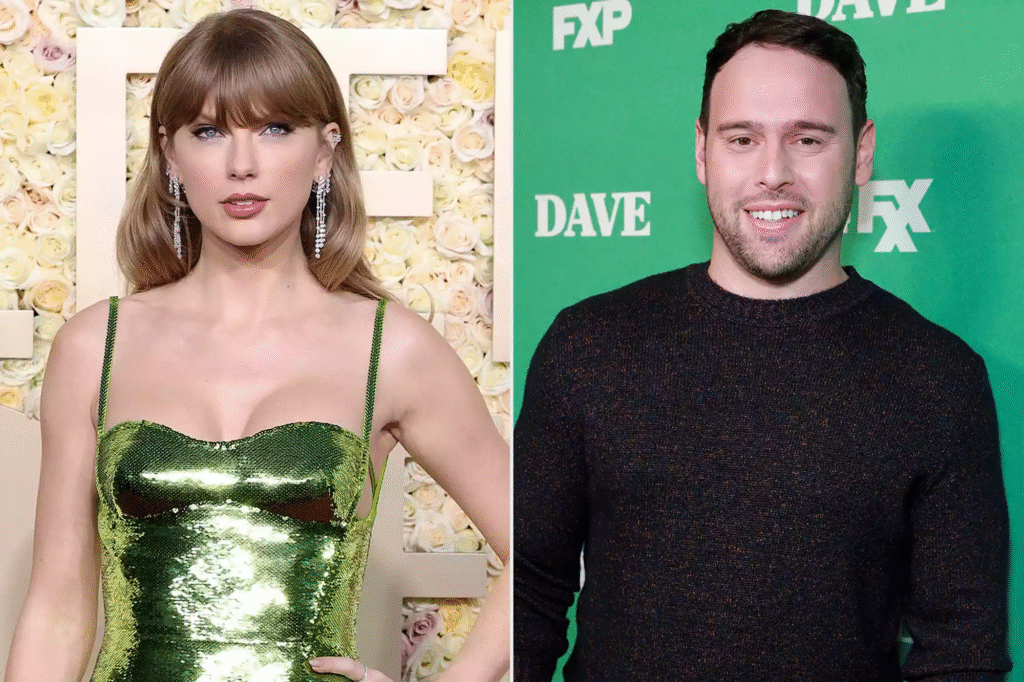
Taylor Swift attends the 81st Annual Golden Globe Awards on January 07, 2024 in Beverly Hills, California
The story between Taylor Swift and Scooter Braun has long captivated the music world, a tale marked by artistic struggle, power dynamics, and ultimately, hard-won liberation. It began in 2019 when Braun acquired Big Machine Records from Scott Borchetta, gaining control of Swift’s first six studio albums. Now, with the release of a new docuseries on Discovery Plus UK in June 2024 and a powerful personal announcement from Swift in May 2025, the narrative has reached a turning point one of ownership, resolution, and renewed purpose.
In an emotional statement shared on her website, Swift expressed a joy that had clearly been building for years. “I’ve been bursting into tears of joy at random intervals ever since I found out that this is really happening,” she wrote. “All of the music I’ve ever made now belongs to me.”
Her declaration marks the culmination of a journey that began in disappointment and led to triumph. In 2019, when Braun purchased Big Machine for 300 million dollars, Swift’s reaction was immediate and deeply personal. Posting to Tumblr, she described years of negotiations that ended with the gut-wrenching realization that her life’s work was no longer in her hands.
That transaction ignited a storm. Celebrity support flooded in from both sides. Close friends like Selena Gomez and Halsey rallied behind Swift, while Braun’s clients, including Justin Bieber and Demi Lovato, defended him. Swift, however, remained focused, announcing in August 2019 that she would re-record her original six albums to reclaim her creative rights.
The battle extended to public stages. In November of that year, Swift accused Braun and Borchetta of attempting to block her from performing her early hits at the American Music Awards. Later, she criticized the release of a live album she did not authorize. In each instance, she confronted a system that seemed determined to silence her, yet each time she responded with clarity and resolve.
Her musical answers spoke volumes. The 2020 release of Folklore featured introspective tracks that echoed her journey. In April 2021, she unveiled Fearless (Taylor’s Version) the first of her re-recordings—and it soared on the charts. The success continued, with each new version deepening her bond with listeners and reestablishing control over her legacy.
Braun, in an interview in June 2021, expressed regret over the situation and called it a misunderstanding. But the damage was already done. Swift continued to explore the emotional fallout in her 2022 album Midnights, especially through songs like “Karma” and “Vigilante.”
Then, in June 2024, Taylor Swift vs. Scooter Braun: Bad Blood premiered, revisiting the conflict with fresh insight. But by then, Swift had already turned the page. As her team made clear, she had moved on, no longer defining herself by the past.
The most powerful moment came on May 30, 2025, when Swift confirmed what fans had long hoped to hear—she once again owned her masters. Rumors circulated that Braun had facilitated the deal, but sources close to the negotiations clarified that he played no role in this outcome.
“Taylor now owns all of her music, and this moment finally happened in spite of Scooter Braun, not because of him,” one insider shared.
Swift’s journey from heartbreak to empowerment serves as an inspiration not only to fellow artists but also to anyone seeking to reclaim what is rightfully theirs. Her story stands as a profound reminder that with courage, perseverance, and authenticity, even the deepest battles can lead to moments of complete freedom.
:max_bytes(150000):strip_icc():focal(707x169:709x171)/cody-franke-barstool-beef-102728-abba61343dff42cab9610e74ad31429d.jpg)
:max_bytes(150000):strip_icc():focal(752x362:754x364)/Cam-Skattebo-new-york-giants-102725-1-405b36577ba1483aaddb55bb8e8e37a9.jpg)


