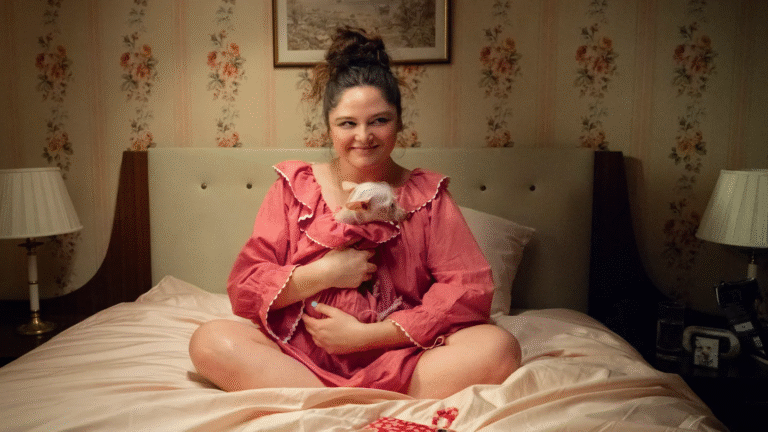
Milly Alcock in the 'Sirens' finale.
As Sirens unfolds across five tightly written episodes, Devon (Meghann Fahy) tries to pull her sister Simone (Milly Alcock) from the gilded but suffocating grip of the elite Kell household—led by socialite Michaela “Kiki” Kell (Julianne Moore) and her powerful husband Peter (Kevin Bacon).
When a photo of Simone kissing Peter surfaces—an act initiated by Peter—it triggers chaos. Michaela is devastated, Peter leaves her, and Simone appears to take her place. This betrayal, especially after Simone’s earlier closeness with Michaela, leaves viewers reeling. Yet Peter’s manipulative charm had long been a quiet pull for Simone.
Meanwhile, Devon departs the island alone, returning to Buffalo to care for their ill father. She sees Michaela leaving as well—each woman left to rebuild without the identity of the Kell name.
Fahy admitted the twist was “unexpected,” while Alcock described it as “deeply troubling.”
“We wanted Simone to emerge fractured yet real,” Alcock said. “She’s not empowered in a Hollywood sense—she’s surviving in a way that’s devastatingly honest. That truth hit me hard.”
Fahy added, “It surprised me too, but it felt right. Simone isn’t looking for redemption—she’s looking for safety, and sometimes that means compromising what we thought she valued.”
Metzler defended the ambiguous conclusion, saying, “It gives the audience power. They can choose how to feel—angry, empathetic, betrayed. That’s the point.”
Kassell pointed out how society often blames women when relationships fall apart. “Devon is blamed for disrupting Ray’s marriage. Michaela is blamed for Peter’s past infidelity. But Peter? He escapes real scrutiny,” she noted.
“He targeted Simone—someone half his age—offering her the illusion of rebirth, of freedom, all while reinforcing the same old power structures,” Metzler added. “It’s an ancient myth retold: the woman becomes the villain, while men like Peter remain untouched.”
As Devon tries to “save” Simone from her lavish captivity, she forces her sister to confront old wounds—abandonment, grief, and self-worth issues. But Simone’s new identity, however painful or ill-fitting, is one she’s carved out of desperation.
“Simone is hard to sympathize with, I get that,” Alcock said. “But she’s not evil. She’s a woman who sees no better option. No degree, no money, no support system. So she takes the lifeboat that’s offered.”
Devon, too, is flawed. Fahy admitted, “Devon’s idea of rescue isn’t selfless. She wants Simone back in the mold she remembers. But people change. And sometimes, rescuing is just another form of control.”
Kassell acknowledged that Simone’s selfishness can be hard to digest, especially when it leads to Michaela losing everything. “But Simone didn’t destroy Michaela. Peter did. He set the terms. Simone just tried to survive within them,” she said.
“Simone’s not a hero. But she’s not a monster either,” Metzler emphasized. “She’s someone who learned, painfully, that survival isn’t always beautiful.”
The show invites the audience to wrestle with shifting roles. Metzler noted, “You might think Simone’s the villain, or Peter is. Or maybe Michaela. It all depends on who you believe deserved more.”
Near the end, Devon and Michaela meet again. There’s no grand reconciliation—just an honest recognition of each other’s broken edges. “Devon always seemed so sure of herself,” Fahy said. “But her strength was a distraction from her fear of being vulnerable.”
And then there’s Simone—standing alone on the same cliff where the story began.
“That image is everything,” Metzler said. “It’s not a fall or a triumph. It’s just Simone—choosing something, finally. Not for Devon, or Peter, or anyone else. For herself.”
All episodes of Sirens are now streaming on Netflix.